Scootnanigans
Category: dribblings
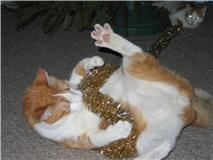
This is a picture of West Coast Suzy’s cat, Scooter, fighting some Christmas tree garland. I’m told the cat in the background is named Tigger.
I got to thinking about if I had a cat named Scooter, what I would actually call it. I’ve talked before about how I shorten names and honestly, Mister Biscuits is more often called Pitters than anything else. I had a friend who had a cat named Black Natty. It was a black cat and natty was her way of calling any cat. Kind of like kitty. So if she saw your cat she’d be all, “Who is this natty? What a wittle natty.” That kind of thing.
If I had a cat named Scooter I’d call him Scoots McGoots. Then probably just Scoots.
And mostly Pitters.
So creative and yet, so lazy.
***
Do you listen to podcasts? I do. I enjoy the funny ones. In no order here’s the one’s I try to keep up with:
NPR’s Fresh Air
NPR’s Pop Culture Happy Hour
How Was Your Week with Julie Klausner
You Had to be There with Sara Schaefer and Nikki Glaser
WTF with Marc Maron
Extra Hot Great
The Moth podcast
ESPN Baseball Today
I also just started listening to Aisha Tyler’s Girl on Guy. Whatchoo listen to?
5 Comments | PermalinkTeam Edward
Category: dribblings
Sometimes I just want Edward James Olmos to call me up and give me a 3o second motivational speech about how I’m going to get through my day/evening because I’m great and human and survived this far blah blah blah.
And he’d end with, “So say we all.”
And I’d be all, “Thank you, sir.”
“SO SAY WE ALL.”
oops. “So say we all.”
“SO SAY WE ALL!”
“SO SAY WE ALL!” with tears streaming down my face.
Oh, like I’m the only one?
Leave a Comment | PermalinkTags: BSG
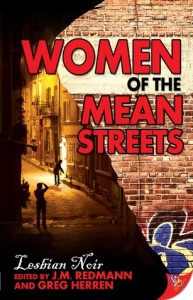
When I saw the cover of this book I was all, “Cool!”
And when I read the synopsis I was all, “THIS is going to be AWESOME.”
Here’s the synopsis:
Women. Crime. Justice. At least the search for it. On the mean streets, the back allies, the dark corners.
These are stories of tough women in hard places. The nights are long, the women are fast, and danger is always a short block or quick minute away. Edited by award winning author/editors J.M. Redmann and Greg Herren, Women of the Mean Streets is an anthology of some of the top, tough women crime writers today, noir stories with a lesbian twist.
See? How could I not give this a shot?
Turns out, my expectations were really high. I was thinking that the book would be short stories about P.I.s, detectives, maybe bounty hunters? Now where would I get that idea? Was it the “mean streets, the back allies, the dark corners”? Was it the Mickey Spillane-y cover? Yes and yes. Out of 13 stories maybe five or six have those type of characters, but the other half? I don’t think they understood the assignment. I’m not blaming the authors, they wrote good(ish) stories, but some of them didn’t belong in this book.
Three or four of the stories took place in the suburbs. I’m not saying you can’t have noir in the suburbs, you totally can, but c’mon, not exactly “mean streets” there. Also, the last story is science fiction. Again, I’m not saying there’s no such thing as noir in science fiction, but look at that cover and read that synopsis again. You can make a case for those stories. You can push the envelope, in fact, please do, and say that since they (the suburban and sci fi stories) are dark stories they fit the bill. I love pushing the boundaries. But in this case, with these stories, it just doesn’t work.
On the stories themselves, I’d say four were totally worth reading and the rest were very forgettable.
If my expectations were too high and I’m judging this anthology too harshly, I’m sorry. I was really hoping for something like Nicola Griffith’s Aud series, only with short stories, or maybe The Maltese Falcon but with lesbians. Maybe if it had had a different cover, or if the title and description weren’t so heavy with the hardboiled style I could’ve just read it as a book with dark, creepy stories. But I feel like they’re selling this book as one thing and giving you something else. That’s dirty pool.
Leave a Comment | PermalinkTags: fiction, Nicola Griffith
Public. Library.
Category: dribblings
There’s a lady’s been coming in to the ‘brary and she starts talking from the moment she steps through the door until she finally leaves. We call her Gabby. She tells us the same things over and over. Also? she loves to read trilogies. Also, also, she pronounces it tree-ology.
“Do you have the fourth book in this tree-ology?”
“I’m not, wait, fourth book?”
“Yes, I really like tree-ologies. This one has four books in it. Is it in?”
My co-worker, who is NOT HELPING comes up, “Yeah Jaimie, do we have the fourth book in that *slight pause* tree-ology?”
I give her a dirty look.
Back to Gabby I say, “I think the word you’re looking for is series.”
“No, I’m looking for the fourth book in this tree-ology.”
“It’s checked out.”
*****
This whole exchange was a full 10 minutes:
The other day we had a lady come in, she didn’t know the title, she knew the author’s last name started with the letter A, and that the book was nonfiction.
“Ma’am, I’m sorry that’s too broad a search. Do you know what the book is about?”
“Not really, but I’ve seen it here before.”
“Right.”
“If you could just take me to the A’s in nonfiction.”
“…”
“I know where the nonfiction section is, but I can’t find where the A’s start.”
“The nonfiction is in numerical order first. There’s not an A section.”
“But the author’s last name starts with A.”
“Right, and that would be useful if it were fiction, or perhaps a biography.”
*insert another futile attempt at explaining the Dewey Decimal System here*
She walks away disappointed. She comes back three minutes later with the book she was looking for.
“Oh my gosh, how did you find it?”
“I just went over to the section where I had seen it before and looked around till I found it.”
I murdered her with a shelf marker.
****
Yesterday a little girl peed on the carpet by the fish tank.
6 Comments | PermalinkTags: library
18. Dead Funny: Humor in Hitler’s Germany by Rudolph Herzog translated by Jefferson Chase
Category: 50 Books

This very short book covered more ground than I thought it would. The author starts in 1933 and ends with Mel Brooks’ The Producers and Roberto Benigni’s Life if Beautiful. The book itself reads like an interesting textbook. I’m not going to blame this on the fact that the book is translated because that is not the problem. The problem is the subject matter, and I’m not talking about the history of the Third Reich either. I’m talking about jokes.
Political humor, at it’s very best, is only funny for a very short time, and even then, how funny is it? Not that funny, is my point. Also what’s not funny? Racist jokes. So the problem here is that most of the humor that is discussed in this book is of course, political humor and racist jokes. When two of the unfunniest types of humor are being disected and explained, even if it’s putting them into their cultural relevance, it’s tedious. Which is why I compare it to a textbook. This is not to say the book is boring. It is not. It’s fascinating.
But it isn’t entertaining. If you’re not into history or historical popculture, I’d stay away from this book. However, if you do like history and if you’re interested in any way about humor during the Third Reich, who used it and how and why, get this book. It’s very short, very readable, the subject matter is engaging, and had me thinking about it after I’d put the book down. The way the people used political jokes and the establishment used racists jokes was absolutely fascinating to read about. To think about people, comedians, actors, being put to death for telling a joke or acting in a sketch that made fun of the government? Terrifying.
One thing I found surprising about the book is that when the 1960s and ’70s are discussed, there’s no mention of Monty Python’s Flying Circus. I’m certain they made fun of Hitler. It’s curious that their sketches aren’t mentioned.
Leave a Comment | PermalinkTags: nonfiction
Jaimie’s True Crime Summer Reading Program continues with a break from the Third Reich.
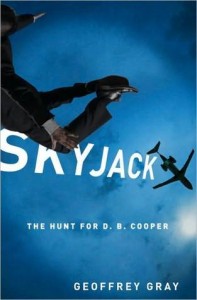
This book is a good overview of the D.B. Cooper case. In 1971 a man going by the name Dan Cooper hijacked a plane and actually got away with it.
The book adds some new characters, and when I say characters I mean it. (Everyone in this book is awesomely crazy.) The author does a really good job of making these people very human and interesting. (read: crazy.) And even though he writes about these very dedicated/obsessed people he still manages to keep the tone respectful. Mr. Gray breaks the story down into three parts: The Jump, The Hunt, and The Curse. What a great idea, because he often jumps around to different characters as well as points in time, so this way the sections of the book gel together better. At first, all the jumping from person to person was really confusing and kind of maddening (mostly because of the jumps in time, he’d go from 1971 to something in 1980 to 2008 back to ’71. It was annoying at first.) but if you stick with the book, you learn the characters and it gets easier to follow.
My favorite part of the book was The Curse because it shows how the people who get involved in the mystery really get swept up in it. They all obsess over it, and in most cases it really takes over their lives; even the author succumbs. Which, I don’t know. The author is a reporter, a journalist, and he gets involved and writes about himself? And to me that’s kind of no good. Again, my opinion, but if you’re a reporting on a mystery, and you’re not part of the mystery (a suspect in it/solving it) then why are you in the story? In this particular book the author writes himself in, I think, to show that he too goes a bit bonkers when he gets sucked into the mystery. I’m not saying it’s bad, it’s just a gray area is all.
The writing is good, the story moves along, there are a million characters, but they are all so unique so you’re not bogged down all, “Who?” The only thing wrong here is that there is no ending. The mystery isn’t solved. The suspect the author favors at first is easily eliminated halfway through the story, kind of making the story not a story anymore. It then becomes about the curse of the mystery driving people crazy. When I finished the book I wasn’t satisfied. I was just sad thinking about all of these very unhappy people whose lives were ruined for seemingly nothing.
Will I read another book by this author? Yes.
Will I read another book about the D.B. Cooper case? Probably not. It’s way too messy and filled with way too many wacky people. And by too many wachy people I’m talking about all the people who claim to have been Dan Cooper.
One more thing, the jacket cover for the book was excellent.
Leave a Comment | Permalink
Tags: books, D.B. Cooper, nonfiction, true crime
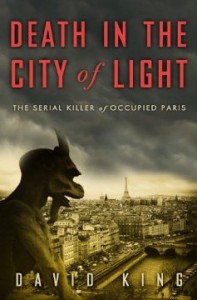
What’s this? A serial killer? Paris? and Nazis? I’m in.
This historical true crime book reads like a novel, and is so facinating I couldn’t put it down. Mr. King writes about Dr. Marcel Petiot and how he prentended to work for the French Resistance during the Nazi Occupation of Paris. He would trick people (read: Jews) into thinking he was helping them get out of the country and then he would kill them and steal their money. People think he was responsible for at least one hundred murders during this time.
This book will no doubt be compared to Erik Larson’s The Devil in the White City, and it’s a pretty good comparison. They both have stories revolving around a historical time period (World’s Fair/Occupied Paris) and a serial killer. What’s so great about reading historical true crime is you get to read about true crime and not feel like a total weirdo. You can tell your friends you’re reading historical nonfiction and feel like a smarty!
The writing in the book was good. The story flowed. There weren’t any slow or boring parts. The author did a great job of blending Dr. Petiot’s story into what was going on in Paris with the Occupation and what some of the more famous people in Paris were doing at the time. I will say that the ending wasn’t as satisfying as I’d hoped, though this has more to do with the actual history than the writing. When you find out that the main detective who’d been working the case for years didn’t get to catch Petiot, or even interrogate him, because the detective was charged with collaborating with the enemy (he was later cleared but had to miss the capture and trial of Dr. Petiot.) the ending is kind of lackluster. Although the trial was a crazy circus and pretty entertaining to read.
If you like true crime, Erik Larson’s books, and learning about World War II without getting too indepth about concentration camps, definitely give Death in the City of Light a shot.
Pun totally intended.
Shot, get it? No? Well if you read the book you’ll get it.
****
Death in the City of Light by David King is available 9/20/2011 from Crown Publishing.
Leave a Comment | PermalinkTags: nonfiction, true crime
We are trend.
Category: dribblings
Pardon me while I nerd-out for a moment. Remember that book I read last month, Sex on Six Legs by Marlene Zuk? Well, the author was on Fresh Air this week, and she’s talkin’ bugs. It’s great, give it a listen.
Leave a Comment | PermalinkI miss my local AM oldies station.
So now that I’ve no tunes in my jeep I have to sing to myself.
Question:
What song did Jaimie sing in the Jeep on her way to work this morning?
A. BTO’s You Ain’t Seen Nothin’ Yet (complete with questionable stammering)
B. Debbie Boone’s You Light Up My Life
C. Duran Duran’s Rio
D. Supertramp’s The Logical Song
4 Comments | PermalinkTags: jeep
Now the radio is broken.
gorramit.
Leave a Comment | PermalinkTags: jeep
-
-
'hood life
50 books
art
baseball
ben
birds
books
christmas
church
cookie
crazy margaret
dreams
fellykish
fiction
HCH
jeep
july hates me
laura
lawncare
Lebowski
leetle brahther
library
liz
memoir
mom
movies
mr. fleegan
music
nature
nerd
nonfiction
painting
parents
plumbing
Pop music
popsicle
rant
roxy
Scandinavian crime fiction
sick
sign shop
snakes
toonces
true crime
TV
Fleegans
Non-Fleegans
Swag
- October 2019
- December 2016
- September 2016
- February 2016
- January 2016
- December 2015
- November 2015
- October 2015
- September 2015
- August 2015
- July 2015
- June 2015
- May 2015
- April 2015
- March 2015
- February 2015
- January 2015
- December 2014
- November 2014
- October 2014
- September 2014
- August 2014
- July 2014
- June 2014
- May 2014
- April 2014
- March 2014
- February 2014
- January 2014
- December 2013
- November 2013
- October 2013
- September 2013
- August 2013
- July 2013
- June 2013
- May 2013
- April 2013
- March 2013
- February 2013
- January 2013
- December 2012
- November 2012
- October 2012
- September 2012
- August 2012
- April 2012
- March 2012
- February 2012
- January 2012
- December 2011
- November 2011
- October 2011
- September 2011
- August 2011
- July 2011
- June 2011
- May 2011
- April 2011
- March 2011
- February 2011
- January 2011
- December 2010
- November 2010
- October 2010
- September 2010
- August 2010
- July 2010
- June 2010
- May 2010
- April 2010
- March 2010
- February 2010
- January 2010
- December 2009
- November 2009
- October 2009
- September 2009
- August 2009
- July 2009
- June 2009
- May 2009
- April 2009
- March 2009
- February 2009
- January 2009
- December 2008
- November 2008
- October 2008
- September 2008
- August 2008
- July 2008
- June 2008
- May 2008
- April 2008
- March 2008
- February 2008
- January 2008
- December 2007
- November 2007
- October 2007
- September 2007
- August 2007
- July 2007
- June 2007
- May 2007
- April 2007
- March 2007
- February 2007
- January 2007
- December 2006
- November 2006
- October 2006
- September 2006
- August 2006
- July 2006
- June 2006
- May 2006
- April 2006
- March 2006
- February 2006
- January 2006
- December 2005
- November 2005
- October 2005
- September 2005
- August 2005
- July 2005
- June 2005
- May 2005
- April 2005
- March 2005
- February 2005
- January 2005
- December 2004
- November 2004
- October 2004
- September 2004
- August 2004
- July 2004
- June 2004
- May 2004
- April 2004
- March 2004
- February 2004
- January 2004
- December 2003
- November 2003
- October 2003
- September 2003
- August 2003
- July 2003
- June 2003
- May 2003
- April 2003
- March 2003
- February 2003
- January 2003
- December 2002
- November 2002
- October 2002
- September 2002
- August 2002
- July 2002
- June 2002
- May 2002
- April 2002
- March 2002
- February 2002
- January 2002
- December 2001
- November 2001
- October 2001
- September 2001
- August 2001
- July 2001
- June 2001
- May 2001
- April 2001
- March 2001
- February 2001
- January 2001
- December 2000
- November 2000
- October 2000


Dying is easy, comedy is hard, thoraces are chitinous.

-CZ
www.flickr.com
|


